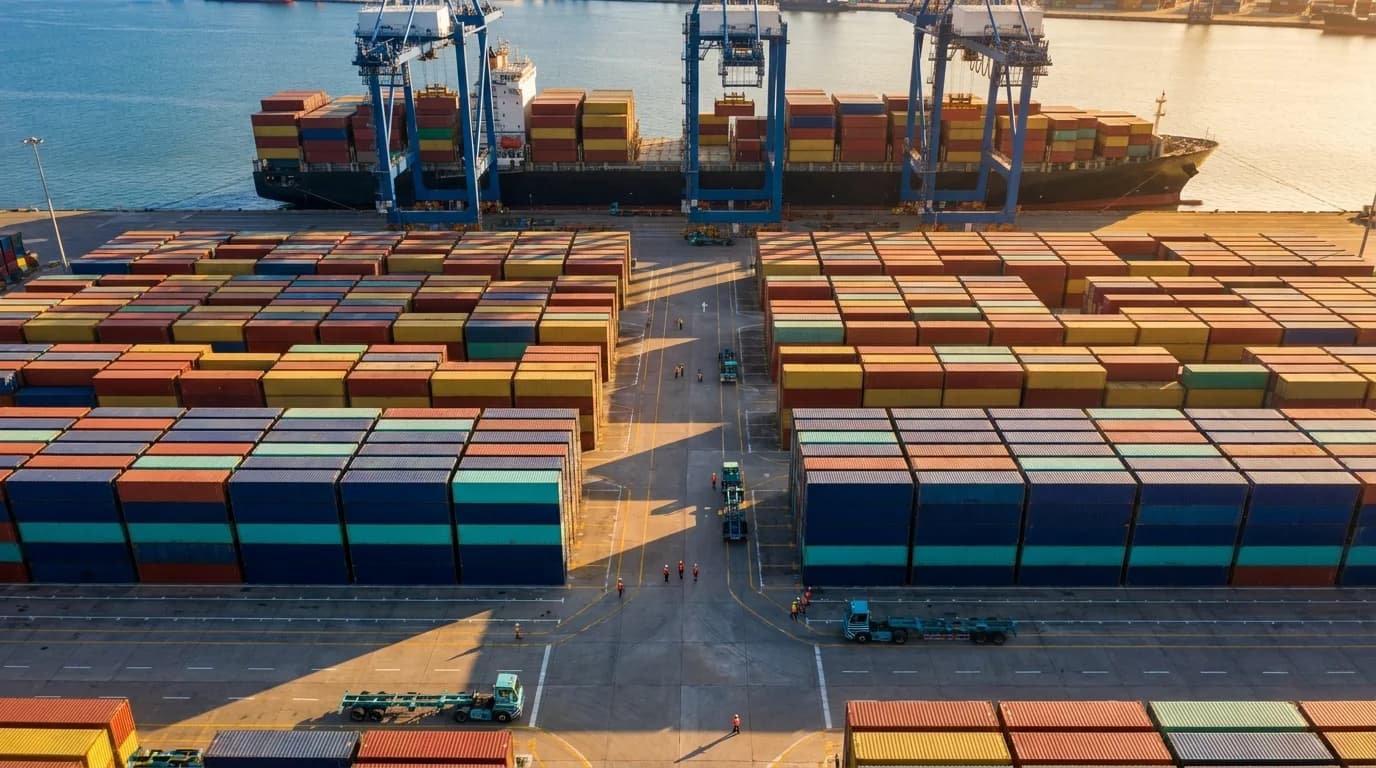
What Are CPT Terms? Carriage Paid To Explained in Plain Language
CPT stands for Carriage Paid To. It is one of the 11 Incoterms® 2020 rules published by the International Chamber of Commerce (ICC), and it works for any mode of transport, including multimodal moves that combine road, rail, ocean and air.
Put simply, the seller books and pays for freight to a destination named in the contract. Legally, though, the seller 'delivers' when it hands the cargo to the first carrier it has engaged. From that moment the buyer carries the risk of loss or damage, even while the shipment is still moving on transport the seller has paid for.
That makes CPT a two-point rule. One point (delivery) decides who wears the risk. The other (the named destination) decides who pays. Most problems with cpt terms come from misunderstanding the gap between those two places.
It also helps to know what the rule leaves out. CPT does not transfer ownership (title), set payment terms or choose the governing law. Those matters belong in the sales contract itself.
What Are the Two Critical Points Under CPT?
Point 1, delivery and risk transfer: the goods pass to the initial carrier at the place of delivery, usually the seller's premises, a forwarder's depot or an origin terminal. Risk moves to the buyer here.
Point 2, the named destination: the place written after 'CPT', such as 'CPT Rotterdam'. The seller's duty to pay for main carriage stops at this location.
Between these points, the buyer is exposed on a journey funded by the seller. For that reason, buyers trading on cpt terms often arrange their own cargo insurance, because the seller has no obligation to insure.
How Do You Name the Place Correctly in a Contract?
Be as precise as you can: a specific terminal, depot or street address rather than just a city or country. 'CPT Rotterdam' leaves open whether carriage ends at the container terminal, an inland depot or the buyer's door, and that uncertainty fuels arguments over who covers terminal handling and on-carriage.
The ICC also recommends identifying the delivery location where risk passes. Where several carriers are involved and nothing has been agreed, risk shifts at the point where the seller's first chosen haulier or forwarder takes over, a party the buyer has no control over. If the buyer wants risk to transfer later (at the origin seaport, for example), the contract has to say so explicitly.
A practical test: could a warehouse supervisor at either end read the clause and know exactly where responsibility changes hands? If not, tighten it.
What Does Good CPT Clause Wording Look Like?
A clear clause states the rule, the exact destination, the delivery point and the Incoterms version. Here is a hypothetical example:
'CPT Euromax Terminal, Maasvlakte, Rotterdam, Netherlands, Incoterms® 2020. Delivery to take place on handover to the seller's contracted carrier at the seller's warehouse, 18 Industrial Road, Dongguan, China. Destination terminal handling charges are included in the seller's contract of carriage.'
Always cite 'Incoterms® 2020' (or whichever version you intend), since older editions allocate some costs differently. Then add explicit wording for any charge the parties want to split another way, such as destination THC, unloading or security surcharges. Spelling these out at quoting stage costs far less than disputing an invoice after the container has landed.

What Do CPT Terms Incoterms 2020 Require of the Seller and Buyer?
Incoterms® 2020 sets out every rule as ten paired obligations, numbered A1 to A10 for the seller and B1 to B10 for the buyer. Reading each pair side by side is the quickest way to see who does each task, who pays for it and who carries the loss if something goes wrong. The official wording is published by the International Chamber of Commerce, which owns and maintains the rules.
Under CPT, the seller clears the goods for export, books transport to the agreed destination and pays the freight, along with any charges that booking includes. The buyer clears the goods for import, pays duties and taxes, and carries the risk from the moment the seller's carrier takes charge of the cargo. Neither side must insure, but the seller has to give the buyer enough information to arrange cover.
One practical test settles most arguments. If a cost sits inside the seller's freight contract, the seller pays it, even when it is incurred at the destination port. If a cost falls outside that contract and arises after delivery, it usually lands with the buyer.
Seller vs. Buyer Obligation Table (A1-A10 / B1-B10)
Here is how the ten pairs divide the work under CPT:
- A1/B1, general obligations. Seller: supply the goods and a commercial invoice. Buyer: pay the price.
- A2/B2, delivery and taking delivery. Seller: hand the goods over to the carrier it contracted. Buyer: collect them from that carrier at the named place.
- A3/B3, transfer of risk. Seller: responsible for loss or damage until delivery. Buyer: responsible from delivery onwards.
- A4/B4, carriage. Seller: contracts and pays main carriage to the destination and meets transport security requirements along the route. Buyer: owes the seller nothing here.
- A5/B5, insurance. Seller: no duty to insure, but must supply information the buyer needs. Buyer: likewise free of any requirement; insures in its own interest if it chooses.
- A6/B6, delivery or transport document. Seller: provide the usual transport document (B/L, AWB, CMR or rail waybill). Buyer: accept it if it conforms.
- A7/B7, export and import clearance. Seller: export clearance, licences and export duties. Buyer: import clearance, duties, taxes and any transit costs the seller's booking excludes.
- A8/B8, checking, packaging and marking. Seller: covers checking and suitable packaging. Buyer: funds pre-shipment inspection unless the export country mandates it.
- A9/B9, allocation of costs. Seller: origin loading, origin THC and freight, plus destination charges and unloading only where its carriage contract covers them. Buyer: post-delivery costs outside that contract, including unloading if excluded, and import duties.
- A10/B10, notices. Seller: tell the buyer the goods have been delivered. Buyer: give notice of time or place of receipt if entitled to set them.
What Changed from Incoterms 2010?
The core logic of CPT stayed the same in 2020. The updates were mostly structural:
- Costs consolidated in A9/B9: every cost allocation now appears in a single article, so disputes are easier to resolve.
- Security requirements made explicit: transport security obligations, such as advance cargo screening, are allocated in A4 and A7.
- Article order revised: delivery and risk moved forward to A2 and A3, reflecting how much they matter.
- CIP, not CPT, changed on insurance: CIP now requires ICC (A) cover, which widened the gap between CPT and its insured sibling.
Worked Example: CPT Rotterdam Incoterms® 2020
Imagine a Dutch distributor buying components from a factory in Dongguan on 'CPT Euromax Terminal, Rotterdam, Incoterms® 2020' at an invoice value of €40,000. The seller's freight booking includes Rotterdam terminal handling.
Seller pays (built into the €40,000): export packing and loading, the pre-carriage truck to Yantian port, export clearance, origin THC, ocean freight and Rotterdam THC.
Buyer pays on top:
- Optional cargo insurance: €90
- Customs brokerage: €150
- Import duty at an illustrative 3.5% of €40,000: €1,400
- On-carriage truck from Rotterdam to a Venlo warehouse: €480
- Unloading at the buyer's dock: €120
Landed cost (excluding recoverable import VAT): €42,240.
Risk passed when the trucking company, as first contracted carrier, collected the container at the Dongguan factory. If the box is damaged at sea, the buyer claims through their own insurance (or against the carrier), not from the seller. Had the buyer skipped that €90 policy, the loss would be theirs to absorb. All figures here are hypothetical, and real duty rates depend on tariff classification.
Tracking each of these charges against the right shipment is where good systems earn their keep. Our guide to freight and logistics software explains how landed costs like these can be captured before the supplier invoice arrives.

How Do CPT Terms in Shipping Work Across Air, Ocean, Road and Rail?
Carriage Paid To is mode-neutral, so it suits containerised, air and overland freight far better than sea-only rules such as FOB or CFR. The legal mechanics hold steady whatever the transport: the seller contracts carriage, delivery is complete once the opening carrier in the chain collects the cargo, and freight is funded all the way to the agreed place.
What shifts from one mode to another is the paperwork and who counts as that first carrier. On an air consignment, it may be a trucker running cargo to the airport rather than the airline. On ocean freight, it is often a haulier or a forwarder issuing a multimodal document.
Operations teams should therefore record exactly who collected the goods, at what time and under which document. That moment is when risk transfers to the buyer.
What Does a Multimodal CPT Route Look Like?
A typical sequence for a containerised shipment:
- Seller's dock: goods are packed, loaded and handed to the trucker the seller contracted. Delivery occurs here and risk passes to the buyer.
- Export clearance: the seller lodges the export declaration.
- Origin terminal: the seller pays origin terminal handling charges (THC) and the container is loaded.
- Main carriage: the ocean, air or rail leg is paid by the seller while the buyer carries the risk.
- Named destination: paid carriage ends, and destination charges fall wherever the carriage contract puts them.
- Import clearance: the buyer clears customs and pays duties and taxes.
- On-carriage and receiving: the buyer arranges and funds transport to its warehouse, plus unloading, unless agreed otherwise.
Which Documents Prove Handover to the First Carrier?
The usual transport document required under article A6 depends on mode:
- Road: CMR consignment note, signed by the carrier on collection.
- Air: air waybill (AWB), now frequently electronic (e-AWB).
- Ocean: bill of lading or sea waybill. A 'received for shipment' or multimodal bill can evidence handover before the vessel is loaded.
- Rail: CIM rail consignment note or an equivalent.
Keep your own dock records alongside the carrier's paperwork: time-stamped load confirmation, seal number, photos showing cargo condition and the driver's signature. These internal records often settle damage arguments faster than anything the carrier issues. If your forwarding tools struggle to tie that evidence to each booking, the signs freight forwarding software can't keep up are worth checking.
How Does CPT Work with Letters of Credit?
The rule pairs well with documentary credits because delivery occurs early, as soon as the carrier takes the goods in charge. Under UCP 600, banks examine only the documents presented. The credit should therefore call for a document that matches the delivery point, such as a combined transport bill showing the place of taking in charge.
Mismatches create discrepancies. A credit demanding an 'on board' ocean bill of lading while the seller hands over at an inland depot can hold up payment. Align the credit wording with the Incoterms clause and the real route before anything ships.
Where Do CPT Disputes Usually Start?
Most arguments fall into three groups:
- Destination charges: buyers receive invoices for destination THC, demurrage or port fees that the seller's freight contract excluded, or that carriers bill twice.
- Damage claims: buyers assume the seller is liable because the seller paid the freight. Under CPT, risk was already with the buyer.
- Delays: the seller's obligation ends at handover, so transit delays are generally the buyer's commercial problem unless the sales contract sets remedies for late delivery.
Precise clause wording and a documented handover prevent most of them. A warehouse system that captures load times, seals and photos at dispatch makes that evidence easy to produce when a claim lands.

How Does CPT Compare with CIP, FCA, CFR, CIF and DAP?
CPT belongs to a family of Incoterms rules where the cost point and the risk point do not always sit in the same place. CIP is CPT plus a seller obligation to insure. FCA stops the seller's freight costs at the delivery point. CFR and CIF follow the same logic as CPT and CIP, but they apply only to waterborne transport. DAP pushes both risk and cost out to the destination.
Picking one is a commercial call about control, appetite for risk and paperwork, not simply a question of the lowest quote. Here is how the six compare.
Six-Term Comparison Matrix
- FCA (all modes): risk moves when the goods are handed to the buyer's nominated carrier, and the seller's carriage costs stop at that delivery point. The seller does not insure.
- CPT (any mode): risk moves at handover to the seller's first contracted carrier, yet freight is paid through to the agreed destination. No insurance is required of anyone.
- CIP (any transport mode): identical risk and cost points to CPT, with one addition: the seller must buy ICC (A) cover as a minimum.
- CFR (sea and inland waterway only): risk passes once goods are on board at the loading port, and the seller funds freight to the port of discharge without insuring.
- CIF (sea and inland waterway only): the same split as CFR, plus seller-arranged insurance at ICC (C) level or better.
- DAP (suitable for every mode): risk and cost both run to the named place, with goods ready for unloading. Cover is not mandated, though the seller bears transit risk regardless.
Insurance Levels: ICC (A) vs. ICC (C)
The Institute Cargo Clauses (A) give 'all risks' cover, subject to the exclusions written into the policy. Clauses (C) protect against a short list of major perils, such as fire, sinking, stranding or collision. Theft and damage from rough handling, for example, fall outside (C).
CIP obliges the seller to buy ICC (A) cover for no less than 110% of the contract value. CIF sets the floor at ICC (C). CPT carries no insurance duty whatsoever, so a buyer who wants the main transit leg protected has to place that policy itself, ideally before collection at the seller's dock.
Why Do CFR and CIF Suit Sea Bulk While CPT Suits Containers?
Under CFR and CIF, risk moves once the goods are loaded onto the ship. That works for grain, ore or coal poured straight from the quay into the hold. Containers behave differently. A seller typically drops a box at an inland depot or terminal days before it is loaded, and from that moment it has no physical control over what happens.
Applying CFR or CIF to containers leaves the seller carrying risk across a window it cannot manage. For that reason the ICC suggests CPT or CIP for containerised freight, because risk passes when the seller gives the box to its contracted haulier.
What Are the Pros and Cons for Buyers and Sellers?
For sellers:
- Pro: they choose the carrier and can build a margin into the freight; risk leaves them early.
- Con: any rise in freight rates or surcharges before shipment comes out of their pocket.
For buyers:
- Pro: a single delivered-freight price, with no international booking to manage.
- Con: they carry the risk on a carrier they did not pick, often with little tracking visibility, and may face unexpected charges at destination.
On balance, cpt terms lean towards the seller. Buyers can even things up by insuring the cargo, naming the destination precisely (down to the terminal or warehouse) and adding service-level clauses on transit times and carrier standards. On the receiving side, recording the Incoterm against each inbound order in your warehouse system also helps, so receiving staff know who owns a claim if a pallet arrives damaged.
When Should You Not Use CPT? A Checklist
Look at a different rule if any of the following apply:
- The cargo is bulk loaded directly onto a vessel (CFR or CIF fit better).
- The buyer needs the seller to arrange insurance (choose CIP).
- The buyer wants to pick the carrier and control freight spend (choose FCA).
- The buyer cannot or will not insure goods in transit.
- The buyer expects the seller to keep the risk until arrival (choose DAP).
- Destination charges are hard to predict and neither side will spell them out in the contract.
- A letter of credit calls for an on-board ocean bill of lading, yet delivery takes place at an inland point.
How Should Warehouses Manage CPT Shipments from Dock to Stock?
Incoterms are drafted by lawyers but carried out by warehouse teams. For the seller, the dock is where delivery and risk transfer physically happen. For the buyer, receiving is where freight charges, damage claims and stock valuation either reconcile or fall apart.
The aim is one time-stamped record linking the purchase order, the agreed Incoterms rule, the transport document, the shipment's transit status and the final receipt. When those details sit in separate spreadsheets and inboxes, arguments about damage, destination charges and landed cost drag on.
What Should a Dock Handover Record Contain?
For every CPT consignment leaving the seller's dock, capture:
- Order and shipment IDs, with the Incoterms rule and named place
- Carrier name, vehicle registration and driver details
- Date and time of handover, which is the moment risk moves to the buyer
- Container and seal numbers
- Piece count, gross weights and packaging condition, supported by photos
- Transport document number (CMR, AWB or B/L)
- Signature from the driver or carrier representative
This record shows the seller met its delivery obligation. It also gives the buyer evidence if an insurance claim follows.
Who Owns In-Transit Inventory Under CPT?
Incoterms deal with risk and cost, not ownership. Title passes according to the terms of sale, which may transfer it on shipment, on payment or on arrival.
For accounting purposes, many buyers recognise goods in transit once risk and control pass. Under this rule, that point arrives at collection by the haulier the seller booked. Agree the treatment with your finance team and auditors, then mirror it in the system with a status such as 'in transit, buyer risk' so stock reports and valuations line up.
How Should Receiving Teams Handle CPT Inbound Loads?
Receiving staff should know a load is CPT before the truck reverses onto the bay. A practical workflow:
- Match the advance shipping notice to the PO and its delivery terms.
- Confirm who pays for unloading and any destination charges.
- Inspect seals and packaging, and note exceptions on the delivery document before signing.
- Photograph damage and record shortages straight away.
- Notify the insurer and the internal claims owner within policy time limits.
- Post the receipt and move stock from in-transit to available or quarantine.
How Do You Calculate Landed Cost on a CPT Purchase?
Under CPT terms, landed cost equals the invoice price plus every buyer-side cost needed to turn goods into usable stock. That includes cargo insurance, customs brokerage, duties, non-recoverable taxes, destination charges outside the seller's carriage contract, on-carriage, unloading and handling.
Returning to the hypothetical Rotterdam purchase, the €40,000 invoice picks up these extra costs on the buyer's side:
- Cargo policy: €90
- Broker's fee: €150
- Duty at the illustrative rate: €1,400
- Truck from the terminal to Venlo: €480
- Dock unloading: €120
Destination THC adds nothing here, because the seller had already paid it under its carriage booking. The landed figure becomes €42,240. Recoverable GST or VAT stays out of the calculation. Allocate the extra €2,240 across SKUs by value, weight or volume so margins and replenishment decisions reflect the real unit cost.
How Do WMS Tools Support CPT Compliance and Visibility?
A warehouse management system can store the delivery terms on each order, timestamp handover and receipt scans, attach transport documents and photos, and track transit status shipment by shipment. Connected properly, those steps can keep a CPT consignment traceable from the outbound dock to the inbound bay, with receiving exceptions and cost data available to finance and claims staff. Fewer gaps in the record mean fewer disputes and cleaner landed-cost figures.
When evaluating a WMS, check whether it can hold the Incoterm and named place as structured fields rather than free text, so reports can filter shipments by rule. It also helps if dock scans can attach seal numbers and photos to the shipment record at the moment of loading, rather than leaving them in a phone gallery or an email thread.
Contact Us to find out more about Expedient Software.
Frequently Asked Questions
When does risk transfer from seller to buyer under CPT?
Under CPT, risk passes to the buyer when the seller hands the goods to the first carrier it has contracted, usually at the seller's premises, a forwarder's depot or an origin terminal. This happens even though the seller is still paying freight to the named destination. If several carriers are involved and nothing else is agreed, risk shifts at the first one, so a buyer wanting a later transfer point must state it explicitly in the contract.
Does the seller have to insure the goods under CPT?
No. CPT places no insurance obligation on either party, although the seller must give the buyer the information needed to arrange cover. Because the buyer carries the risk during main carriage, buyers usually place their own cargo policy before goods are collected. If the buyer wants the seller to insure, CIP requires ICC (A) cover for at least 110% of the contract value.
Can CPT be used for containerised sea freight?
Yes. CPT works for any mode, including multimodal container moves, and the ICC suggests CPT or CIP rather than CFR or CIF for containerised freight. Under CFR and CIF, risk passes only when goods are on board the vessel, yet a seller often drops a container at an inland depot days earlier. CPT moves risk when the box is handed to the seller's contracted carrier, matching when the seller actually loses control.
Who pays destination terminal handling charges under CPT?
It depends on what the seller's freight booking includes. If destination THC or unloading are part of the carriage the seller contracted, the seller pays them; if they fall outside that contract and arise after delivery, they usually land with the buyer. Naming a specific terminal and stating in the clause whether destination THC is included prevents most invoice disputes.
How do you calculate landed cost on a CPT purchase?
Start with the invoice price and add every buyer-side cost needed to turn the goods into usable stock. That covers cargo insurance, customs brokerage, duties, non-recoverable taxes, destination charges outside the seller's carriage contract, on-carriage and unloading. Recoverable GST or VAT is left out, and the extra cost is then allocated across SKUs by value, weight or volume so margins reflect the real unit cost.